No dashboards, no jargon. Below are two example reports with sample data — a free Website Risk Review, and the weekly health report monitoring clients receive.
This is the free first step. A senior consultant looks at your key journeys and sends a short, honest summary of where you're exposed.
Prepared by WebTester Pro · Reviewed personally by a senior QA consultant
Sample report · Example data only
Fern & Forage is a well-built store with a clear purchase path, but three issues expose it to silent revenue loss. The most serious: the checkout's postcode lookup fails on mobile Safari, which quietly blocks a meaningful share of UK mobile buyers. None of these issues would be visible from an uptime monitor — the site was "up" throughout this review.
| Journey | Checked on | Result |
|---|---|---|
| Homepage → product → basket | Desktop & mobile | OK |
| Checkout (guest) | Desktop | OK |
| Checkout (guest) | Mobile Safari | Issue found |
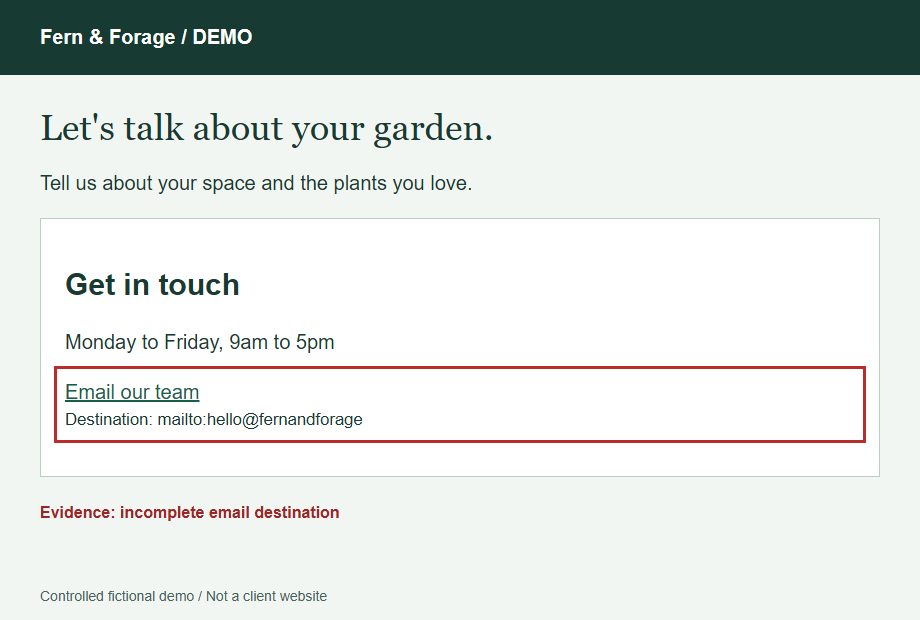
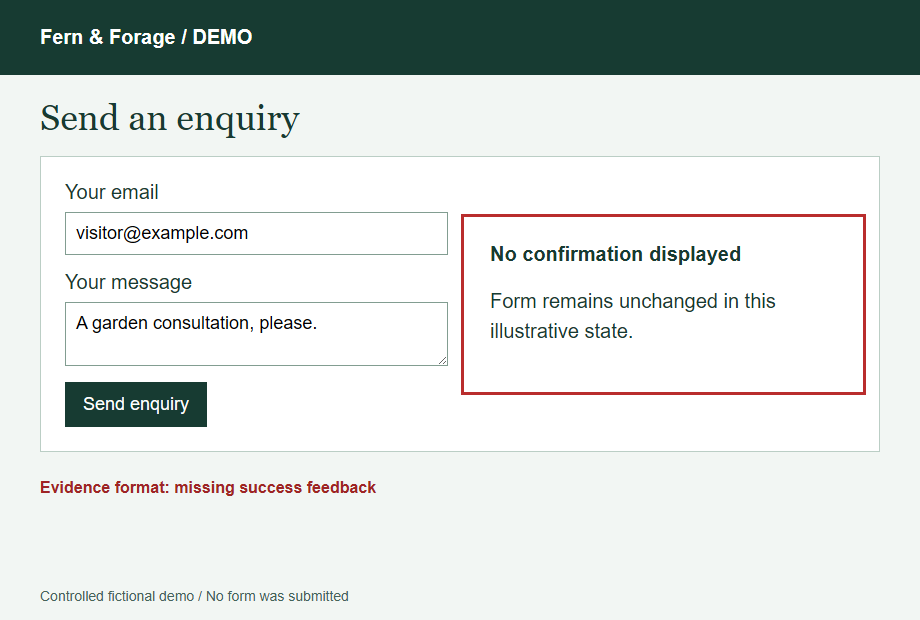
| Contact form | Desktop | Slow — 9s to confirm |
| Account login | Desktop & mobile | OK |
| SSL & trust signals | — | Certificate expires in 19 days |
On iPhone, the address lookup returns an error and the "Continue to payment" button stays disabled. A determined customer can type the address manually, but most won't. Mobile is typically half of a store's traffic — this is the kind of failure that shows up as "sales are quiet this week" rather than an error anyone reports.
Ask your developer to check the postcode lookup script on iOS Safari. Until fixed, enable manual address entry by default.
The form does send, but there's no feedback for 9 seconds. Testing suggests many visitors will click submit repeatedly or leave, assuming it's broken — which produces duplicate enquiries and lost leads.
Add an immediate "sending…" state, and investigate the slow mail handler response.
If auto-renewal is configured this resolves itself. If it isn't, in 19 days every visitor sees a full-page "Not Secure" warning and the store effectively goes offline.
Confirm auto-renewal with your host now, while it's a 2-minute job.
The mobile checkout issue justifies daily journey testing on its own — it was invisible to uptime monitoring and would likely have been discovered by falling sales rather than by anyone seeing an error. For a store of this profile, the Full Coverage plan (checkout + forms + login tested daily) is the right fit; Revenue Protection covers everything except the checkout flow itself.
Every week, monitoring clients get this in their inbox: what was tested, what passed, what failed, and what to do next.
Week 22–28 June 2026 · Revenue Protection plan
Sample report · Example data only
| Journey | Frequency | This week |
|---|---|---|
| Booking enquiry form | Daily | 1 failure — Tue, resolved Tue |
| Patient portal login | Daily | 7/7 passed |
| Key pages (home, services, fees, contact) | Daily | All loading correctly |
| CTA buttons (Book, Call, Enquire) | Daily | All responding |
| Uptime | Every 60 seconds | 100% |
| SSL certificate | Daily | Valid — renews Aug 2026 |
The 07:00 test found the booking form returning an error after Monday evening's plugin update — submissions were failing silently while the page itself looked normal. You were alerted at 07:04 with a screenshot and the error message; your developer rolled the plugin back and the 11:00 re-test confirmed the form working. Estimated exposure: about 4 hours, overnight — versus days if it had waited for a patient to mention it.
One item this week: the plugin that caused Tuesday's failure has a pending update marked as fixing the issue. Suggest your developer applies it in a quiet window — the following morning's test will confirm the form still works, and I'll be watching that run.
Start with the free risk review — a real look at your key journeys by a senior consultant, and a short honest summary of where you're exposed.
No obligation. Replies within one working day.